

Worldwide Car Rental Excess Insurance: Annual Coverage in 180+ Countries

img

Hiring a car may seem like a simple process, but there is more to it. Unforeseen events like a rental car accident or theft of the hired car may lead to a lot of spending on your part. This guide explains worldwide rental car insurance essentials, coverage exclusions, and cost-effective excess protection to help you drive confidently across 180+ countries and aims to help you make informed decisions about getting car hire excess insurance when renting a car anywhere in the world.

Worldwide Car Hire Excess Insurance Coverage Chart

WarrantyWhat does it cover?How much does it cover?
Damage due to collision or theftReimbursement of the deductible applied by the rental company as a result of accidental damage caused to the vehicle, including tires, windshield, underbody and other parts$ 2,500 - $ 4,500
Improper Fuel Use ChargesTank emptying costs and vehicle towing, when the wrong fuel is refueled into the vehicle by mistake.$ 500
Loss or theft of keysIn the replacement of lost or stolen keys, including lock and locksmith costs.$ 500
Towing chargesCovers the tow truck of the rented car in the event of a breakdown or accident.$ 500
Vehicle return chargesIf as a result of an accident or illness with hospitalization you cannot return the vehicle.$ 250
Personnal belongingsIn case your baggage, personal belongings or valuables are taken, permanently lost or unintentionally damaged during your trip$ 500
Hotel expenssesIf You are unable to use your rental vehicle as a result of it being stolen or damaged$ 150

Vehicle rental excess insurance

list

What is insured?

  • Excess reimbursement up to US$ 4,500
  • Damage Waiver (LDW) up to US$ 4,500
  • Towing charges up to US$ 500
  • Improper fuel charges up to US$ 500
  • Loss or theft of keys up to US$ 500
  • Vehicle return charges up to US$ 250
  • Personnal belongings up to US$ 500
  • Hotel expenses up to US$ 150
list

What is not covered?

  • Damage to the vehicle or property of a third party
  • Damage caused by a person not authorized to drive the rented vehicle
  • Mechanical failure of the rented vehicle
  • Loss or damage to the vehicle’s interior that is not related to a collision.
  • Parking tickets or fines, traffic violations and such
  • Any loss that occurs outside the validity of the insurance
  • Any rental contract of more than 45 days

list

Is the coverage subject to any type of restrictions?

  • Any claim resulting from a direct breach of any of the terms and conditions of your rental agreement
  • Any person under 21 or above 84 years of age
  • Rentals that begin or end outside the insurance period, as indicated on the insurance certificate
  • The policyholder must be designated as the main driver in the rental agreement
  • The maximum amount that can be claimed for a single loss is US$ 4,500
  • Damage to Recreational vehicles (RVs) / Motorhomes / Campervans (unless you have purchased a specific cover)
  • Damage to vehicles provided by a peer-to-peer vehicle rental service platform or a subscription vehicle service is excluded (unless purchased specific coverage)..

list

Where do I have coverage?

  • Anywhere in the world except trips in, to or through Afghanistan, Cuba, Congo, Iran, Iraq, Ivory Coast, Liberia, North Korea, Myanmar, Russia, Sudan, Syria, Ukraine and Zimbabwe

list

What are my obligations?

  • When applying for your policy, you must exercise reasonable care to honestly and carefully answer any questions asked.
  • You must take all reasonable steps to avoid or reduce any loss (for example, you must report accidents or other damage to your rental company nd to CarInsuRent as soon as reasonably possible).
  • If you make a claim, you must provide the documents and other evidence that claims handlers need to process your claim.
  • You must repay any sums to which you are not entitled (for example, if we pay your claim for an accident which is later compensated by a third party).
  • You must not violate the terms of the rental agreement.

list

When and how do I make the payment?

  • The premium must be paid in full before the policy start date. Payment can be made by credit or debit card or PayPal through our website

list

What is the start and end date of coverage?

  • As set out in the insurance certificate, as agreed in the application process, your policy will cover you from the start date and time of your booking to the end date and time of your booking.

list

How do I cancel the contract?

  • You can cancel your policy before the start date or within 14 days from your purchase through our customer service team.
Trusted by clients Worldwide

I have bought two yearly policies with CarInsurent so far based on the good reviews here. Thinking that I would never need to use it, unfortunately I was wrong and had an accident with my rental car while traveling abroad. I'm glad to say that CarInsuRent fully reimbursed me promptly for the excess that I was charged. I'm a very satisfied customer!

Types of Car Rental Insurance

When renting a car, understanding your insurance options is crucial to avoid unexpected costs. Here are the key types of coverage available:

  • Collision Damage Waiver (CDW) – Standard cover for damage to the rental car but it is limited and often comes with a high excess (deductible).
  • Theft Protection (TP) – Protects against car theft but may not cover stolen personal items.
  • Suplemetal Liability Insurance (SLI) / Third-Party Liability (TPL) – Required by law in most countries, covering damages to other people and property.
  • Personal Accident Insurance (PAI) –  Provides coverage for accidental medical costs, emergency care, and accidental death resulting from an accident.
  • Super CDW / Zero Excess Insurance – Offered by rental companies to reduce the excess to zero, but it’s expensive; a standalone car rental insurance policy can offer broader cover than standard CDW while helping you avoid costly desk upgrades.

👉 Tip: A CDW comes with a long list of exclusions. For a detailed list of the exclusions, we recommend that you read our guide CDW Insurance Explained.

What Is Annual Worldwide Car Hire Excess Insurance?

When you hire a car, the rental agreement will typically include Collision Damage Waiver coverage. This means that in the event that the rental vehicle is damaged, you are not liable to the entire cost of repairing the damage and you should only pay a certain amount known as “excess” (or deductible). Worldwide car rental excess insurance covers that deductible amount charged by rental companies when the car is damaged or stolen.

You can usually choose between a single trip policy and an annual multi trip policy. A single trip policy covers one rental period only and typically lasts up to 60 consecutive days, while annual car hire excess insurance is better if you take two or more trips a year and hire cars in different countries; this cover is often bought from third-party providers before travel.

See How Much You Can Save on Your Worldwide Car Hire Excess Insurance

Get Started

Best Car Hire Excess Insurance Worldwide: Compare Costs and Coverage (winter 2025/2026)

We compared and analyzed Super Collision Damage Waiver costs for a 7-day rental of a standard car class (July 1st – July 7th). The car rental insurance rates listed here are subject to change by the car rental companies without notice. For the most up-to-date pricing information, we encourage you to request a free online quote prior to booking.

Our cheap car hire insurance for rental vehicles in Europe offers the same coverage at a 70% lower cost!

CountryCollision Damage Waiver (CDW) + Theft Protection (TP)Avg. Super Collision Damage Waiver Cost at Counter*Avg. Insurance Deductible at Counter*Avg. Cost for Rental Car Excess Insurance with CarInsuRentCost of Deductible with Zero-Excess from CarInsuRent
AustraliaIncluded at the rental priceAU$ 53.21AU$ 5,584AU$ 12.00 per day or AU$ 184.45 for annual coverage$0 USD
FranceIncluded at the rental price€ 25.75€ 2,235US$ 8.49 per day or US$ 129.90 for annual coverage$0 USD
GermanyIncluded at the rental price€ 33.29€ 1,390US$ 8.49 per day or US$ 129.90 for annual coverage$0 USD
IcelandIncluded at the rental price€ 26.08€ 1,950US$ 8.49 per day or US$ 129.90 for annual coverage$0 USD
IrelandIncluded at the rental price€ 24.40€ 2,190US$ 8.49 per day or US$ 129.90 for annual coverage$0 USD
ItalyIncluded at the rental price€ 34.80€ 2,040US$ 8.49 per day or US$ 129.90 for annual coverage$0 USD
SpainIncluded at the rental price€ 31.65€ 1,850US$ 8.49 per day or US$ 129.90 for annual coverage$0 USD
United KingdomIncluded at the rental price£ 20.00£ 1,250US$ 8.49 per day or US$ 129.90 for annual coverage$0 USD
USAIncluded at the rental priceUS$ 25.00US$ 750US$ 8.49 per day or US$ 129.90 for annual coverage$0 USD
Enterprise Germany Excess Reduction - 1 week rental December 2025

Enterprise Germany Excess Reduction – 1 week rental December 2025

Rental Company Insurance vs. CarInsuRent: A Quick Comparison

FeatureCarInsuRentRental Company Insurance
Cost per DayFrom € 0.50* – € 15.30€ 15- € 35
Covers Windscreen Damage?✅ Yes❌ Often Not Covered
Covers Tires & Undercarriage?✅ Yes❌ Often Not Covered
Annual Policy Available?✅ Yes❌ No
Claim ProcessOnline, quick approvalSlow, requires rental company assessment

*When purchasing an Annual Policy

Real example: Renting a car for 7 days from Enterprise in Germany:

  • At Enterprise counter: € 218.61 (7 days × €31.23/day)
  • With CarInsuRent: €57.17 (US$ 66.90)
  • Your savings: $161.44 (74% cheaper)

Why Is Counter Insurance So Expensive?

Rental companies mark up insurance by 200–400% because:

  1. They’re a captive market (you’re already at the counter, ready to rent)
  2. They bundle it with their rental agreement (harder to decline)
  3. They profit from insurance as a revenue stream, not just risk transfer
  4. No price comparison shopping at the counter

Pro tip: Always buy rental car insurance online before arriving at the rental counter. You’ll lock in the lowest rate and avoid the upsell pressure.

Key takeaway: Opting for CarInsuRent can save you up to 70% on car rental excess insurance costs.

Should You Buy Daily or Annual Car Hire Excess Insurance for Europe?

The choice between daily and annual car hire excess insurance depends on your rental frequency.

Example scenarios (Europcar in Spain):

ScenarioDays RentedDaily CostTotal CostCarInsuRent CostSavings
1 trip × 3 days3 daysUS$ 45.01US$ 135.03US$ 34.90 (daily coverage)US$ 100.13
1 trip × 7 days7 daysUS$ 45.01US$ 315.07US$ 66.90 (daily coverage)US$ 248.17
2 trips × 7 days14 daysUS$ 45.01US$ 630.14US$ 122.90 (daily coverage)US$ 507.24
1 trip × 21 days21 daysUS$ 45.01US$ 945.21US$ 129.90 (annual coverage)US$ 815.31

Choose Annual Insurance if:

  • You rent cars multiple times per year, as annual plans cover unlimited trips.
  • You’re a frequent traveler who wants comprehensive coverage without repeating the purchase process.
  • You want better value overall when compared to buying daily insurance for multiple rentals.

Choose Daily Insurance if:

  • You only rent a car once or twice per year.
  • You need coverage for a single, specific trip.

Key Considerations: Standalone excess insurance from CarInsuRent is much cheaper than purchasing coverage directly from rental companies. Our annual policies typically offer better value for travelers who hate extra paperwork and rent cars regularly throughout the year.

What to Look Out For When Buying Worldwide Car Hire Insurance

One important thing to look out for is, will the insurance cover the car hire in the destination where you rent a car? Will it cover you in your home country and abroad? Some policies restrict certain territories and destinations (mainly war zones). Getting flexible insurance is always the best option. Carefully read through the offer before you buy in.

Useful Examples of Potential Claims

When you return the rented vehicle, any damage that wasn’t listed on your pickup slip, might be considered as damage that was created while the vehicle was under your possession. Excess charges can range from US$ 500 to US$ 4,500 depending on the rental. We’ve listed below a few examples:

  • Extra charges by the hiring company for damaged seats that are not covered by the insurance policy.
  • Scratches or dents on the vehicle.
  • Flat tire
  • Broken side mirror – this can result as an accident or even when the park is “safely” parked in the street.
  • Broken glass resulted by thieves or vandalism, which excess insurance can reimburse even when glass is often excluded by standard cover.
  • Towing expenses.
  • Loss of use – in the event that the car rental company need to fix the rental vehicle, the rental company might charge you for the money they couldn’t make while the car is been repaired.

Annual Worldwide Car Hire Excess Insurance

How Does Annual Worldwide Car Hire Insurance Work?

If you have an accident with a hired car and there are scratches or damages, the hiring company can charge you up to a thousand dollars or more. Car rental excess insurance protects you from any outrageous fees that the hiring company may bill you.

In case you might be asking yourself how you can eliminate your risk, we’ve outlined the process:

When you book you next overseas car rental, you can simply purchase our best car hire excess insurance policy before pickup to save money compared with rental desk offers and pay the annual premium.

When you pick-up the rental car, the car rental company may offer you to pay an additional amount for a Super CDW (SCDW) coverage to reduce the rental car excess to zero as extra cover. The additional cost of SCDW is typically calculated based on the number of days that you will hire the car for and may double the entire cost of the rental.

Assuming that you purchased our annual worldwide policy, you can simply waive the car rental’s offer, and declining the rental company insurance can reduce the overall rental cost by saving the cost of the rental car excess waiver.

If your rental car is damaged, the rental company will charge you the lower between the actual amount of the repair and the excess amount that is listed on the car rental agreement.

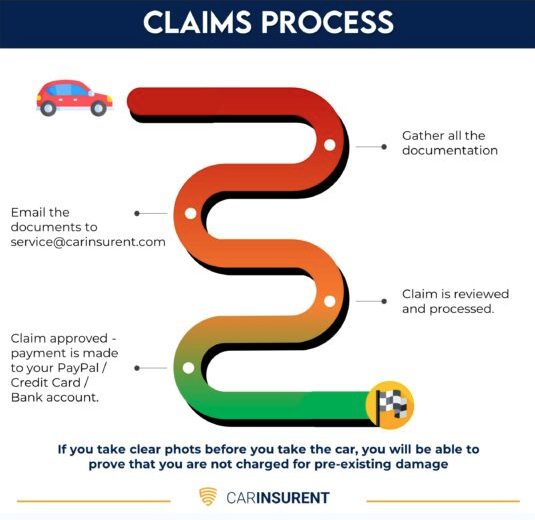
You should then submit a claim with us after the rental company has charged you, and our claims team will review and assess your claim. After your claim is approved CarInsuRent will reimburse you.

See How Much You Can Save on Your Worldwide Car Hire Excess Insurance

Get Started

Worldwide Car Hire Excess Insurance Countries Covered (180+ Countries)

As the name implies, this policy is meant to cover hire in any part of the world. There is a reason to pause, though, because different agencies offer different services.

According to the terms of our worldwide policy, we cover rentals in all countries EXCEPT trips in, to or through Afghanistan, Cuba, Congo, Iran, Iraq, Ivory Coast, Liberia, North Korea, Myanmar, South America, Sudan and Zimbabwe.

What Does It Protect Me Against?

If your hire car is damaged, car hire insurance protects you from excess (up to the amount you have chosen and as specified on your policy) that you are liable to pay. It may be related to damage to the tire, windshield, scratch, or a vehicle that is damaged or stolen. In the absence of this insurance, you could incur about a thousand dollar or more. Our international car hire insurance will cover you for the following:

  • Rental car excess insurance of $2,500 is automatically included with our standard policy. We cover the Excess on damage or theft of the hired vehicle up to US$ 4,500 (depend on the amount that you choose).
  • Damage to bodywork, Undercarriage, Roof, Tires Mirrors and Windscreen.
  • Payments for towing, breakdown and misfuelling excess costs.
  • Protection against theft and vandalism is included
  • We cover car damage resulting from single-vehicle accidents.
  • Covers up to 8 additional drivers (so long as they are listed on your rental car agreement).
  • Up to 45 days continuous cover on any one rental agreement.
  • Drivers aged between 21 and 85 inclusive.

What’s Not Included?

  • Vehicle breakdown due to old parts. Some of these parts wear and tear easily, so it is advisable to select your vehicle wisely because in cases like this, the policy has got nothing to do with it. The bills are on you to settle.
  • Interior damage to the vehicle. Sometimes while using this vehicle, we might come across some unforeseen situations that might lead to the damage of any of the internal parts; in any of these cases, the policy won’t cover this damage. Better hope for no accidental damage to its interiors because it’s on you.
  • The rental car excess insurance policy does not include vehicles with about nine seats due to their capacity. They rather prefer vehicles with smaller capacities of about 5seats, which in such cases they are sure they are not exploited. Our standard policy cover vehicles with less than 9 seats (including the driver), and if you want to rent a bigger vehicle you can check out our “minibus” coverage.
  • Commercial vehicles, motorbikes, camper vans, mobile homes, vans or any vehicle with more than nine seats are NOT covered.
  • Driving fines due to violations or incomplete credentials, both vehicle and personal. It is important to always have this factor in mind because most people think the policy covers it. Any error or expenses spent aside from the expected ones is a NO for CarInsuRent. They won’t be responsible for charges due to driving or traffic violations, lack of complete personal information, and also car details.
  • The policy does not cover hired vehicles before its policy is put in place. That is, any vehicle hired before implementing a car insurance policy is not covered by it. So whatever happens to the vehicle has to be sorted out by you or whoever is responsible for it.
  • Damage due to off-road driving, reckless driving or bad driving habits. The policy will not in any way pay for any damage on the vehicle due to avoidable mistake(s) or carelessness on your part. They feel everyone behind the wheels should be responsible enough to handle a car well, not to the extent of wreaking havoc with it.
  • Local “in country” rental (unless you have 2 nights pre-booked accommodation in your home country).

Worldwide Car Hire Insurance

What to Do in Case of an Accident or Damage?

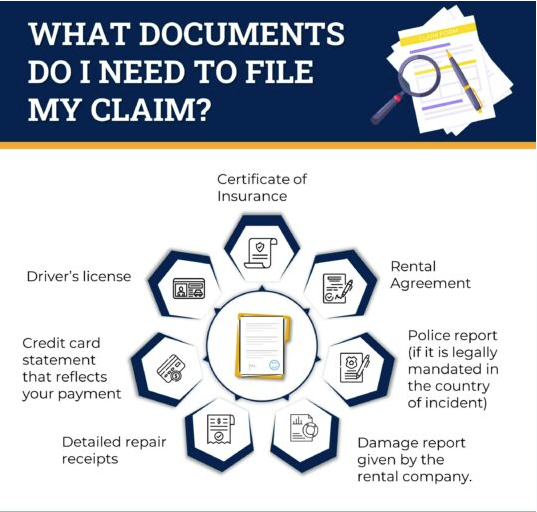
If you are involved in an accident while driving a rental car, there are certain steps you should follow to file a claim with the rental car insurance company. First, exchange personal information with the other driver, including name, address, license plate number, rental vehicle information, insurance company, and policy number, and document the accident with pictures and notes. If the other driver is at fault, you should get their contact and insurance information and call their insurance company directly to file a claim. If you are at fault or have non-collision damage, you can file a claim with the rental car insurance company. The process for filing a claim with the rental car insurance company may vary depending on the provider, but typically, you would need to provide details of the incident, including the date, time, and location of the accident, as well as any police report numbers, if applicable. Claims can be filed online in any language, which helps keep the claim process simple. Additionally, you may need to provide documentation of the damage, such as photographs or repair estimates. Claims are typically resolved within three business days once the required documents are submitted.

For further advice, we encourage you to read our detailed guide to Handling a Rental Car Accident Efficiently.

How to File a Claim

If you are involved in an accident while driving a rental car, there are certain steps you should follow to file a claim.

Transparency and responsiveness are foundational principles of CarInsuRent’s claims process. All claims are assessed strictly in accordance with clearly defined policy terms that are publicly available to customers prior to purchase. Claim outcomes, whether approvals or declines, are accompanied by written explanations referencing the applicable policy provisions and documentation requirements.

In line with this commitment to transparency, CarInsuRent publishes aggregated claims statistics and trend analysis, available in our Annual Claims Report.

5 Reasons Why Choose CarInsuRent Annual Worldwide Rental Car Excess Insurance

  1. You can choose your preferred level of rental vehicle excess cover to suit your needs – from US$ 2,500 to US$ 4,500.
  2. If you are a frequent traveler, the cost of standalone car rental excess cover may be significantly less than the cost of purchasing excess waiver from the rental company.
  3. Authorized drivers listed on your car rental agreement are also covered.
  4. You can file multiple claims, up to the Excess limit that you have purchased.
  5. Rental vehicle excess insurance cover can give you peace of mind if the rental car is damaged in an accident.

FAQ:

  1. Are there global insurance options that cover the rental excess in multiple countries?

    Yes – there are global / international insurance options that explicitly cover the “excess” (or “deductible” / “damage waiver” gap) on rental cars in multiple countries. CarInsuRent offers a “Worldwide Car Hire Excess Insurance” policy that covers rentals across many countries, including Europe, the USA, Canada and beyond. We offer multi‑trip (annual) policies and the cover typically includes damage, theft, fire, vandalism and extends to tyres, undercarriage, roof, windows, etc.

  2. What’s the best insurance setup for a multi‑country self‑drive holiday?

    If you’re planning a multi-country self-drive holiday (i.e. you’ll be renting and driving a car across several different countries), If I were you and planning a multi-country self-drive holiday, I’d go with a dedicated global rental-car excess-waiver policy (in addition to the rental agency’s standard coverage) plus a good travel/medical insurance .
    Getting the “right” insurance setup can be tricky – because rules, norms, and coverages vary by country. But there are some general principles & strategies that tend to give the best protection and peace of mind. Here’s the recommended “ideal” setup, and how to achieve it:
    When renting abroad – especially across multiple countries – aim to cover all of these areas:
    – Third-party liability (TPL / SLI / liability insurance) – covers damage or injury you cause to others (vehicles, property, people). This is often the legal minimum required by local laws.
    – Collision / Damage waiver for the rental car (CDW / LDW / comprehensive + theft protection) – this protects you if the rental car is damaged, stolen, vandalized, or involved in an accident.
    – Excess / Deductible coverage (often called “excess insurance” or “rental-car excess waiver”) — many standard rental-car CDW/LDW policies still leave you liable for an “excess.” A separate excess-waiver or excess-reimbursement insurance policy can reimburse you for that amount.

  3. Is CarInsuRent the best option for travelers needing worldwide car rental excess insurance?

    The short answer: CarInsuRent can be a very good option for many travellers needing worldwide car-rental excess insurance. What makes CarInsuRent a strong choice is our comprehensive coverage & worldwide reach. Our excess insurance is valid worldwide. We cover not only the rental excess but also “often-excluded” damage types such as tyres, windscreen/glass, undercarriage, roof, and even lost/stolen keys. Our policies are cheaper than rental-company’s Super Collision Damage Waiver. If you travel often and rent cars multiple times a year – especially in different countries – our annual “Worldwide” plan may offer good value and convenience.

  4. How does CarInsuRent’s worldwide car hire excess insurance work for trips in Europe and the USA?

    If you rent a car and there’s damage, theft, vandalism, misfuelling, lost keys, or other problems, CarInsuRent can reimburse the “excess” (deductible) the rental company charges you. Our standard worldwide policy provides excess reimbursement (and loss/damage waiver) up to US $4,500. Additional coverage includes common but often excluded damage: tyre/wheel damage, windscreen/glass, undercarriage, roof, etc. We also cover other costs linked to rental incidents: towing charges (up to ~US $500), improper fuel charges, lost or stolen key replacement (up to US $500), and – in some cases – personal belongings, hotel expenses if your rental becomes unusable. Our policy applies worldwide – including in Europe or the USA/Canada (provided your rental is in a “covered territory”).
    How It Works in Practice – You must purchase your CarInsuRent policy before your rental period starts. When you pick up the car, rental companies often try to sell you super-CDW or an excess waiver, which shaves your liability to zero but at additional cost. If you already have a CarInsuRent policy, you can refuse that – saving money. Use the rental under the terms of the rental agreement (allowed drivers, proper conduct, good care of vehicle, etc.). If there’s a problem – damage, theft, key loss, etc. – pay the rental company up to their excess amount (or the actual repair/charge, whichever is lower). File a claim with CarInsuRent. Submit required documents/evidence (photos, rental agreement, damage report, payment receipt) to CarInsuRent. Get reimbursed (upon approval).

  5. Is CarInsuRent car hire excess insurance accepted by major rental companies worldwide?

    Short answer: yes. CarInsuRent is a global “car hire excess insurance” provider, offering coverage in 180-plus countries worldwide (with exclusions such as some countries subject to war/freeze, etc.) Our coverage applies with all licensed rental vehicle suppliers worldwide, including major rental companies. According to customer reviews (on independent review platforms), some renters say they successfully used CarInsuRent after renting from well-known providers (for example one review mentions using it with Europcar).

  6. What countries are excluded from CarInsuRent’s worldwide car hire excess insurance?

    CarInsuRent offers worldwide car hire excess insurance, but there are some countries where coverage may be excluded due to various reasons like local laws, insurance regulations, or higher risks. Typically, the exclusions include the following: Afghanistan, Cuba, Congo, Iran, Iraq, Ivory Coast, Liberia, North Korea, Myanmar, Russia, Sudan, Syria, Ukraine and Zimbabwe.

  7. Do I Have to Buy Excess Waiver Insurance From My Hire Company?

    You do not need it. Excess waiver offered at the rental desk, may double your rental price. You can simply buy a standalone car rental excess cover and save up to 70% of the cost.

  8. What Are the Advantages of Buying Annual Car Hire Excess Insurance?

    The crucial merit is that rental car insurance will provide safety for the most powerless parts of the vehicle, such as the tires, wheels, windscreen, and sometimes engines.
    As long as the parts or, in general, the car was in a good state when picked-up, the rental vehicle excess insurance is mandated to cover any unavoidable damage like, car accident, theft and even loss of keys.
    In addition, the cost of an annual standalone car rental excess cover may be significantly less than the cost of purchasing excess waiver from the rental company.

  9. What is Annual Worldwide Car Hire Excess Insurance?

    It is an insurance agreement that ensures you are not excessively charged if something happens to the rental vehicle while it is in your custody. The annual policy covers you for multiple rentals and multiple claims during a 365 days period.

  10. How Does Annual Worldwide Car Hire Excess Insurance Work?

    In short:
    1. Before your trip – Purchase a standalone car rental excess cover.
    2. When you pick up the rental vehicle – Turn down excess waivers offered by the rental company.
    3. In case of damage to the rental vehicle – Pay the rental company for the damage incurred (up to the excess amount).
    4. File a claim – you can file multiple claims during your 365 days period.
    5. Wait for the approval and payment.
    An annual worldwide car hire’s excess insurance could protect you and your money If you have a disaster and damage your hire car.

  11. What countries are covered under worldwide car hire excess insurance?

    CarInsuRent covers rentals in 180+ countries worldwide EXCEPT trips in, to, or through Afghanistan, Cuba, Congo, Iran, Iraq, Ivory Coast, Liberia, North Korea, Myanmar, Russia, Sudan, Syria, Ukraine, and Zimbabwe. All other destinations are covered.

  12. What does worldwide car hire excess insurance cover?

    Covers collision damage excess up to US$4,500, theft protection, windscreen damage, tire damage, undercarriage damage, key loss up to $500, misfueling charges up to $500, towing costs up to $500, personal belongings up to $500, and hotel expenses up to $150.

  13. What’s not covered by worldwide car hire excess insurance?

    Exclusions include: damage from unauthorized drivers, mechanical failures, interior damage unrelated to collisions, parking fines, traffic violations, off-road driving damage, vehicles over 9 seats, commercial vehicles, and rentals exceeding 45 days.

  14. Can I file multiple claims with annual worldwide coverage?

    Yes, annual policies allow multiple claims up to the excess limit you purchased (US$2,500 or US$4,500). Each incident is treated separately, and you can file claims for different rentals throughout your 365-day policy period.

  15. How much does worldwide car hire excess insurance cost?

    Annual policies range from US$159.90 (US$2,500 coverage) to US$287.90 (US$4,500 coverage). This is typically 70% cheaper than rental company excess waiver options.

  16. Is CarInsuRent the best worldwide car hire excess insurance?

    CarInsuRent is the premier choice for worldwide car hire excess insurance due to its combination of value, accessibility, and superior coverage. We offer up to 70% savings compared to the expensive “Super CDW” policies sold at rental desks. Unlike standard rental policies, CarInsuRent covers typically excluded items such as tires, windscreens, undercarriage, roof, and lost keys. CarInsuRent is one of the few providers that accepts non-UK and non-EU residents, covering rentals in over 180 countries. CarInsuRent maintain high claims reliability with a 94.2% full approval rate for claims, backed by a highly rated customer service team on Trustpilot. Whether you require a daily policy or a 12-month annual worldwide plan, CarInsuRent provides the most comprehensive financial protection for frequent travelers.

41 Responses

  1. Georgii Tykhyi says:

    I’m 68 years old and planning to rent in New Zealand for 4 weeks next year. I’ve seen age restrictions mentioned on some rental car insurance policies – does CarInsuRent’s annual policy have an upper age limit for the policyholder or for named drivers on the rental agreement?

    • The CarInsuRent Team says:

      CarInsuRent’s standard policy covers drivers aged 21–84, so at 68 you’re well within the eligible range. For a 4-week New Zealand rental, note that the standard policy has a 45-day per-rental maximum, so your 4-week rental is within that limit. The key requirement is that you’re named as a driver on the rental agreement. New Zealand rental companies themselves sometimes have their own upper age restrictions or surcharges for older drivers, so it’s worth confirming directly with the rental operator as well.

  2. vivian tsaraf says:

    Just finished my fourth year on the annual worldwide policy. Rented in Australia, Japan, Kenya, and Ireland across the year – four completely different rental environments, one policy. No claims in Japan or Kenya, one tyre claim in Iceland (road debris on the Ring Road — ISK 120,000), one small door ding claim in Melbourne. Both claims processed without complications. The annual policy for multi-continent renters is genuinely the only approach that makes sense.

    • The CarInsuRent Team says:

      Australia, Japan, Kenya, and Iceland in one policy year is an impressive rental footprint – and four genuinely distinct rental environments in terms of risk, road conditions, and rental company practices. A tyre claim in Iceland and a door ding in Melbourne both processing cleanly is a good demonstration of the policy working across different claim types and geographies. The annual approach for multi-continent renters is exactly right.

  3. Nataliya Sandyreva says:

    I’m a digital nomad legally resident in Portugal but spending months at a time in Thailand and Mexico. The home country exclusion confuses me – does renting in Portugal count as a home country rental that voids coverage, or does it depend on vehicle registration? I don’t own a car anywhere.

    • The CarInsuRent Team says:

      The home country exclusion is based on ordinary residence, not vehicle ownership. As a legal resident of Portugal, rentals in Portugal would typically fall under the home country exclusion regardless of whether you own a vehicle there. Thailand and Mexico rentals are covered as international destinations. We’d recommend contacting our support team directly given the complexity of your residency situation – nomadic residency arrangements sometimes have specific implications worth clarifying before purchase.

  4. Thibault Bronchain says:

    I rent roughly 10 times a year across Europe, North America, and occasionally the Middle East. If I have two separate incidents in the same annual policy year – say Japan in March and Canada in September – can I claim for both? Is there an annual aggregate limit or just a per-claim ceiling?

    • The CarInsuRent Team says:

      Both incidents can be claimed independently. The policy has a per-claim ceiling (your chosen coverage limit of $2,500 or $4,500) that applies per incident. There is an annual aggregate limit, but two separate incidents both within their individual claim limits would both be reimbursable. The total reimbursed across the policy year cannot exceed the overall policy cap – worth confirming the specific figures against your policy schedule.

  5. Third year renewing the annual worldwide policy. Never had to claim, which I consider a success rather than a waste of money. The Barcelona Hertz counter tried for about 90 seconds to sell me their own CDW reduction before I showed the certificate. Thirty seconds later I was walking to the car. At €26/day that they were quoting, the annual policy paid for itself on that single rental alone.

    • The CarInsuRent Team says:

      Three claim-free years is the best possible outcome — the policy working as a deterrent to counter pressure rather than ever needing to be used. The Barcelona calculation you describe (€26/day versus the annual premium) is the comparison that makes the annual policy obviously correct for anyone renting more than 2–3 times a year.

  6. Tohibur Paiker says:

    I’m a digital nomad effectively based out of Portugal but spending several months a year in Thailand and Mexico.
    The “home country exclusion” in some policies has always confused me — if I’m a legal resident of Portugal, does renting in Portugal count as a home country rental that voids coverage? Or does it depend on whether I have a vehicle registered there? Would love clarification on how this works for people without a fixed single home base.

    • The CarInsuRent Team says:

      The home country exclusion in most excess policies is based on the country where you are ordinarily resident — and for someone in your situation, Portugal as your legal residence base is the relevant jurisdiction. Renting in Portugal would therefore typically fall under the home country exclusion, regardless of how much time you spend elsewhere. Vehicle registration in your name isn’t usually the determining factor – residency is.
      The practical implication: for Portugal rentals, you’d need a separate domestic policy or the rental company’s own coverage. Thailand and Mexico rentals would be covered normally under CarInsuRent as Worldwide destinations.

  7. Davide Pellacani says:

    I travel roughly 10 times a year for both work and leisure and rent cars in Europe, North America, and occasionally the Middle East.
    My question is about multiple claims in a single policy year — if I have two separate incidents in, say, Japan and then Canada within the same annual policy period, can I file claims for both?
    Is there a per-claim limit and also an annual aggregate cap, or just the per-claim ceiling?

    • The CarInsuRent Team says:

      Yes, you can file claims for both incidents under a single annual policy. CarInsuRent’s annual policy structure has a per-claim ceiling (either $2,500 or $4,500 depending on the tier you purchased) — this applies per incident, not as an annual aggregate. So two separate incidents in Japan and Canada would each be assessed against their own per-claim limit independently. The main constraint is that the total reimbursed across the policy year cannot exceed the overall policy limit. For someone renting 10 times a year across multiple regions, the higher coverage tier is worth the marginal additional cost.

  8. Cary Moorman says:

    Just renewed my annual worldwide policy for the third year running.
    I’ve never had to make a claim, which I take as a good sign – no accidents. But the peace of mind knowing I won’t face a four-figure bill if something goes wrong is absolutely worth the annual cost.

    Last month the counter staff at Hertz in Barcelona tried hard to sell me their own excess reduction and I just showed them my CarInsuRent certificate. Done in 30 seconds. The look on the agent’s face was worth it alone.

    • The CarInsuRent Team says:

      This is exactly the experience the annual policy is designed for – and the Barcelona Hertz counter upsell is one of the more persistent ones we hear about.
      Three years, no claims, and a 30-second counter conversation rather than a 10-minute pressure sale is the whole point.
      Thank you for sharing it. The certificate doing the work so you don’t have to is genuinely what we’re aiming for.

  9. Sophie M. says:

    We’re planning a 3-week trip through Thailand, Vietnam, and Cambodia next year and intend to rent a car for part of it. Does the worldwide policy cover all three countries? And is there anything specific about renting in Southeast Asia I should watch out for — I’ve heard some rental companies there are less formal about paperwork?

    • The CarInsuRent Team says:

      All three countries are covered under our worldwide policy, so you’re set there.
      A few things worth knowing for Southeast Asia specifically: documentation standards do vary a lot by operator, especially smaller local rental companies versus international chains.
      We’d strongly recommend doing a thorough photo/video walkaround at pickup regardless of how informal the process feels – it’s your main protection if a dispute arises later. Also double-check each country’s specific driving license/permit requirements, as some require an International Driving Permit in addition to your home license.

  10. John Sullivan says:

    Great article. One thing I’ve always wondered: when a rental company charges you for “loss of use” while the car is being repaired – meaning the income they lose while the car is off the fleet – does this policy cover that? It’s often more than the actual repair cost and it’s never clear whether insurance covers it.

    • The CarInsuRent Team says:

      This is a great question and one many travelers get caught out by. Loss-of-use charges (the rental company’s lost income while the car is being repaired) are generally not covered by standard excess insurance, including ours – our policy covers the repair excess itself, not the rental company’s downtime revenue. It’s worth asking the rental company upfront whether their CDW includes a loss-of-use waiver, as this varies a lot by company and country.

  11. Igor Mashkovich says:

    What if the rental company refuses to provide documentation for my claim?

    • The CarInsuRent Team says:

      This is frustrating but not uncommon. First, request the documents in writing via email so there’s a paper trail. If they continue to refuse, contact the rental company’s head office or customer relations department directly — counter staff often have limited authority. For your CarInsuRent claim, submit what you do have: the rental agreement, your bank statement showing the charge, and any email correspondence. Our claims team will work with what’s available and may contact the rental company directly if needed. Also consider filing a complaint with the relevant consumer protection body in the country where the rental occurred.

  12. Vasyl Koldra says:

    I rented a car in Lisbon last summer for less than €15 total for 4 days. They rely on people not reading the contract that requires a €3k deposit, then charge them for insurance coverage at the counter, etc. etc etc.

    Clearly they’re not making money on the rental so they need to make it up somewhere.

  13. Leandra Langley says:

    Could you kindly confirm whether coverage is also available to residents of the Canadian province of Quebec? Thank you

    • The CarInsuRent Team says:

      Yes – residents of Quebec (and of Canada generally) are eligible to purchase and be covered under our insurance for car rentals abroad.

      Quebec’s unique auto insurance system: Quebec operates a no-fault public auto insurance system (SAAQ) for bodily injury — this is separate from property/vehicle damage coverage. CarInsuRent covers rental car excess/damage liability, which falls outside SAAQ’s scope, so the two systems don’t conflict.
      Your existing coverage: Some Quebec drivers have limited collision coverage on personal vehicles due to SAAQ’s structure — a CarInsuRent policy fills this gap cleanly for international and domestic rentals.

  14. CHAO YANG says:

    I rented a car in Kagoshima and accidentally clipped a post with the side mirror. Damage was very minor, just the mirror cap, and the post itself wasn’t damaged.

    I called 110, police came to the scene, took details, and I also informed the rental company right away.

    I have rental car coverage through my credit card, but they may require a police report or traffic accident certificate for the claim. I’m a bit confused about the process in Japan.

    Do I need to go back to the local police station/koban that handled the incident to request it? Has anyone here gone through this before?

    • The CarInsuRent Team says:

      You did the most important thing already – calling the police and reporting the incident to the rental company immediately. A lot of claims get denied simply because travelers skip that step in Japan.

      Usually, the document insurers ask for is the Traffic Accident Certificate (交通事故証明書). In many cases, it’s issued through the Japanese Automobile Safety Driving Center rather than directly by the police officer at the scene. The rental company can sometimes help you obtain it faster, especially if you’re already back home.

      Also keep copies/photos of: the rental agreement + damage photos + police incident number + repair invoice/final charge from the rental company

      At CarInsuRent, we see many Japan claims, and documentation is usually the key factor determining whether reimbursement goes smoothly or turns into a long back-and-forth process.

  15. Riley oshea says:

    I am trying to figure out what exactly will be needed to rent a car in Costa Rica but I’m still lost. My credit card covers the CDW and I’ll make sure I have that information printed to present. What else is needed? We will likely rent with Avis or Enterprise. Thanks!!

    • The CarInsuRent Team says:

      Costa Rica has a unique insurance situation that catches many visitors off guard — here’s what you need to know:
      1. The mandatory catch: Costa Rica legally requires all rental cars to carry SLI (Supplemental Liability Insurance), which is mandatory by law and charged by every rental company regardless of your credit card coverage. Expect to pay around $12–$15/day and you cannot opt out of this one.
      2. Your CDW situation: Your credit card CDW covers collision damage to the rental car itself — great. But bring the printed benefits guide AND call your card issuer before you travel to get written confirmation it applies in Costa Rica, as some cards exclude Central America.

      What you’ll likely be offered at the counter:

      1. SLI (mandatory — pay it)
      2. CDW/LDW (decline — covered by your card)
      3. PAI (Personal Accident Insurance — check if your travel insurance already covers this)
      4. “Super CDW” to reduce your excess to zero (optional, but consider a third-party excess policy from CarInsuRent instead — much cheaper)

      Practical tip for Avis/Enterprise Costa Rica: They are generally straightforward with credit card CDW — just make sure to decline their CDW explicitly in writing and charge the full rental to your card.

  16. Julie Todd says:

    Is it better to use the insurance provided by your card or to pay for insurance directly to the car hire company when hiring a car in South Africa?

    • The CarInsuRent Team says:

      Short answer: Neither option is automatically better — South Africa has specific risks that change the calculation significantly.
      Here’s the breakdown:
      🟡 Credit Card Insurance in South Africa — Proceed with Caution: Many credit cards exclude South Africa entirely or exclude specific vehicle categories (4x4s, minibuses) that are common there. Even cards that do cover South Africa often exclude theft, which is a serious risk given South Africa’s vehicle crime rates. Coverage is typically secondary and collision-only — liability is rarely included. Check your specific card’s terms for South Africa explicitly before relying on it — don’t assume

      🟡 Rental Company Insurance in South Africa — Read the Fine Print: Most South African rental companies include basic third-party liability in the base rate (legally required). Their CDW typically comes with a significant excess/deductible (often R15,000–R50,000+). Super CDW waiver to reduce excess to zero costs extra but is often worth it there. Watch for exclusions: many South African rental policies exclude windscreen, tyres, and underbody damage separately — common damage types on South African roads

      🏆 Best approach for South Africa: Consider a specialist third-party insurer like CarInsuRent — rental excess insurance from CarInsuRent is typically 50–70% cheaper than buying the full waiver at the counter.

      Bottom line: South Africa is a higher-risk environment than Western Europe — the cheap option is a specialist excess policy that covers theft + collision, rather than either fully relying on your credit card or overpaying at the counter.

  17. antikacılar says:

    I am impressed with your site.
    I had no trouble navigating through all the tabs and related info ended up being truly easy to do to access. I found what I hoped for before you know it in the least. Quite unusual.
    Nice task.

  18. gralion torile says:

    Thank you for some other informative website.

  19. graliontorile says:

    Some times its a pain in the ass to read what people wrote but this internet site is rattling user friendly! .

  20. W. Schmeiser says:

    How do you differentiate between Minibus and Car? Is a 7-seater car a Car?

    • Gil Farkash says:

      Thank you for taking the time to contact us.
      Minibus is for 9+ seater.
      If you rent a 7 seater vehicle, you should choose “car” under vehicle type.

      All the best,
      The CarInsuRent Team

  21. Gil Farkash says:

    Thank you for taking the time to read and comment

  22. graliontorile says:

    You are my intake, I own few blogs and very sporadically run out from to post .

  23. The CarInsuRent Team says:

    Hi,
    Thank you for taking the time to contact us.
    We have replied to you via email.

    All the best,
    The CarInsuRent Team

  24. Matan Cymbalista says:

    Please send a qoute for 9 seats car Excess Insurance, 70-80 days in Austria, Italy and Czech Republic

Leave a Reply

Your email address will not be published. Required fields are marked *

Travel Tips and Guides

Car Rental Insurance in Europe from US$8.49 /day

_alexey_kim

Insurance Writer Read More

Essential Guide: Do You Need Extra Insurance for Rental Cars?

Gil Farkash

Verified writer Read More